Friday, July 27, 2012

The Race To The Center

One of the most fascinating rituals of presidential election politics is what I like to refer to as "The Race To The Center."  This race has two legs – starting in the center, the candidates first sprint far enough to their party’s political extreme to get the nomination, then promptly try to get back to the center ahead of their opponent in order to win the race (ie, the election).  Let me explain.

The American electorate of course covers the political spectrum, from extreme liberal to extreme conservative.  No one would seriously disagree that the extreme left is the Democratic base and the extreme right is the Republican base.  While the reality is that this spectrum is a messy bell curve with moderates occupying the largest, central sector, it is simpler to think of this spectrum as linear. 


That means, obviously, that to get the nomination, each candidate has to appeal to the most extreme parts of his/her party - its base.  However, to get elected, the candidate then has to turn around and appeal to the center, because their base is not large enough to win.  Hence, The Race To The Center. 

Like all races, winning depends on a number of factors.  The first, and arguably the most important, is how far they have to run. If they started the campaign running far to the extreme, they have farther to run to get back to the center. How long that initial leg is depends on the willingness of the base to shorten it by moving to the center (or, more accurately, not making him/her run all the way to the extreme) to meet the candidate.

The next most important factor is the speed (ability) of the runner/candidate. Rhetorically, a good runner can cover more ground than a slow one.  The corollary to that is the speed/ability of the opponent.  The winner doesn't have to be fast, he just needs to be faster than the loser.

The third factor is the intangible of luck. Again, the winner doesn't have to be very good if the opponent stumbles, or if the opponent's race course is strewn with obstacles. 

Finally, and most cynically, this is a race of perception, with tens of millions of judges/voters.  It doesn't really matter what the runner actually believes.  All that matters is what the judges think about the candidates.

Now that the nominations are secured, the candidates have completed the first leg of the race.  It is frankly entertaining to watch them now run back to the center and try to convince moderates and independents that they aren’t really the extremists they pretended to be on the nomination leg of the race.  In the end, do we really know what they actually believe?  Probably not.

Thursday, July 26, 2012

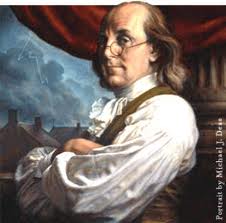
What would Ben Franklin think of the 21st Century Post Office?

TWO HUNDRED THIRTY-SEVEN YEARS AGO – Benjamin Franklin was appointed the first Postmaster General of the soon-to-be United States by the Continental Congress on July 26, 1775.  Franklin had served as postmaster of the British American colonies from 1737 until he was dismissed in January, 1774 for “pernicious activity” in connection with the rising colonial rebellion.  

Franklin is certainly one of the most fascinating figures in American history.  His extremely readable autobiography, which covers much of his early life, has been used in schools for more than a century.  He was a self-made man, famously starting from humble origins and ending as one of the richest men in America.  One part of this remarkable life that has intrigued so many over the years are the novel ways in which Franklin obtained his wealth, including a primitive form of franchising his printing business, vertical integration (at one time he was the largest manufacturer of paper in the colonies) and, of course, frugality.
 

The anniversary of Franklin’s Postmaster General appointment may be a good excuse for considering the plight of the current U.S. Postal Service.  Franklin actually made the British postal system profitable through management and innovation.  He was never afraid of change, having been responsible during his lifetime for improvements in such diverse fields as electricity, government, meteorology, civic organization, insurance, and more.  What do you think Ben Franklin would have thought about an expensive, bloated, and bureaucratic system rapidly being made obsolete by modern technology and changing customer needs?  Do we really think that this no-nonsense businessman would have supported efforts to prop-up what has clearly become a make-work, unionized jobs program?  Just food for thought.


To end this on a politically correct note (readers know how important that is to me!), those interested in a different view of Franklin should see Joseph Ellis’ Pulitzer prizing wining history Founding Brothers.  Chapter Three - The Silence - discusses Franklin’s impassioned role in early efforts to abolish slavery.

Sunday, July 15, 2012

Jimmy Carter's Malaise

President Jimmy Carter’s presidency was marked by a number of significant national problems, including a continuation of the “energy crisis” which had begun with the OPEC reductions in oil output in the early 1970s.  Having already made four speeches on the subject, Carter felt in the summer of 1979 that another was needed, but that the American people were no longer listening. In preparation, he consulted Democratic leaders from Congress and around the county.  His pollster believed that the American people simply faced a crisis of confidence because of the assassinations of John F. Kennedy, Robert F. Kennedy and Martin Luther King, Jr.; the Vietnam War; and Watergate.  Based on those consultations and that information, on July 15, 1979 - thirty-three years ago today - he gave  the now-famous televised address that has become known as the “Malaise Speech” (ironically, the word “malaise” was not actually used).  The following is the heart of the talk:
"I want to talk to you right now about a fundamental threat to American democracy. . . . I do not refer to the outward strength of America, a nation that is at peace tonight everywhere in the world, with unmatched economic power and military might. The threat is nearly invisible in ordinary ways It is a crisis of confidence. It is a crisis that strikes at the very heart and soul and spirit of our national will. We can see this crisis in the growing doubt about the meaning of our own lives and in the loss of a unity of purpose for our nation. . . .

"In a nation that was proud of hard work, strong families, close-knit communities, and our faith in God, too many of us now tend to worship self-indulgence and consumption. Human identity is no longer defined by what one does, but by what one owns. But we've discovered that owning things and consuming things does not satisfy our longing for meaning....

"I'm asking you for your good and for your nation's security to take no unnecessary trips, to use carpools or public transportation whenever you can, to park your car one extra day per week, to obey the speed limit, and to set your thermostats to save fuel.... I have seen the strength of America in the inexhaustible resources of our people. In the days to come, let us renew that strength in the struggle for an energy-secure nation. . . ."
Although it has since been almost universally criticized, it was not immediately seen as a failure.  The New York Times ran the headline "Speech Lifts Carter Rating to 37%; Public Agrees on Confidence Crisis; Responsive Chord Struck" later that week.  

How much did this realistic (almost pessimistic) speech contribute to Carter's resounding defeat by the upbeat, optimistic and charismatic Ronald Reagan less than sixteen month's later?  It's of course impossible to tell, but it's tempting to believe that it (or the tone that it represents) was at least a part of the story.  Undoubtedly the President was correct, but you have to wonder how much consolation that was to him after the election.

UK National Health Insurance - 100 years ago

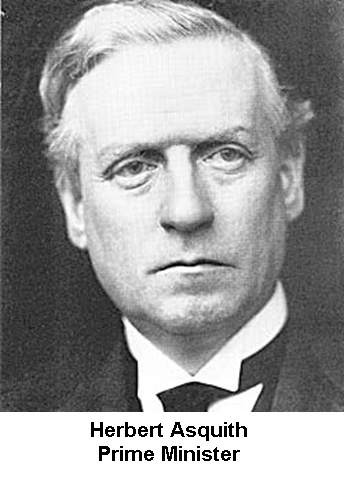
In the midst of the highly-charged political debate over “Obama Care” (or the Affordable Care Act, if you prefer), it is interesting/ironic to note that the UK’s National Insurance Act of 1911 went into effect on July 15, 1912 – 100 years ago today.  This measure gave the British working classes the first contributory system of insurance against illness and unemployment and is often regarded as one of the foundations of modern social welfare in the United Kingdom.  Aside from the remarkable coincidence in dates, the other truly fascinating aspect of this era in British history is its imperfect parallel with Lyndon Johnson’s Great Society efforts in his 1965 – 1969 Presidential term.

The Liberal Party won a landslide victory in the election of 1906, after the Conservative Party split over the issue of tariffs.  A large segment of the Conservatives, abandoning a century of free trade dogma, wanted protective tariffs to insulate British merchants from the rising tide of competition from America, Germany and others.  This became a class issue, as the poor understood that tariffs could lead to higher food prices.

It is important to understand that “Liberal” in this sense means largely upper and upper-middle class Britons who were for the most part dedicated to the social status quo.  The “liberals” in the modern sense were actually the Labor party, which didn’t fully come into its own until after World War II.

The Liberal government’s extensive social welfare proposals were driven by David Lloyd George (Chancellor of the Exchequer), Winston Churchill (President of the Board of Trade) and others.  Perhaps not surprisingly, the program was controversial, and the fight with the Conservatives reached its climax over the 1909 “Peoples Budget.”  This intentionally confrontational funding plan, described as among the most controversial in British history, systematically raised taxes on the rich, especially the landowners, to pay for the welfare programs (and, incidentally, naval expansion).  In the end, the budget passed and was the tool that the Liberals used to finally break the power of the conservative House of Lords.

As a footnote, 1906 was the last election won by the Liberal Party.  That is not, however, a pro-Conservative judgment against social reform, as the Liberal’s place was taken by the Labor Party which continues to this day to be one of the two major British political parties.

As noted above, there is something of a parallel with the Great Society efforts of the mid-1960s.  Note particularly the lopsided electoral mandate for social change (although not, of course, the only election issue in either case), followed by sweeping, class-based enactments that fundamentally altered the social and political landscapes of each country.  For a very readable account of this dramatic era in British history, you may want to check out Barbara Tuchman’s The Proud Tower, which is an entertaining summary of some of the major world trends and events between 1895 and 1914. 

Sunday, July 8, 2012

The Great UFO Cover-Up?

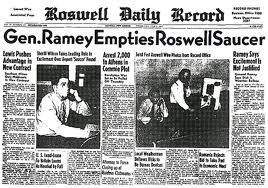
SIXTY-FIVE YEARS AGO - Officials from the public information office at Roswell Army Air Field issued a statement on July 8, 1947, claiming that a crashed “flying disk” had been recovered by military personnel from a nearby farm.  

The following day, the commander of the Eighth Air Force stated that a radar-tracking balloon had crashed and been recovered, not a “flying disk.”  A later press conference displayed what was said to be wreckage and which appeared to verify the General’s explanation.

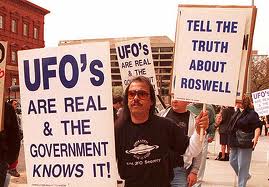
The incident leapt from obscurity in 1978, when one of the officers involved in the recovery told a “ufologist” (i.e., one who studies UFOs) that the military had recovered an alien spacecraft and had covered up the fact.  From that point, the story acquired a life of its own, including everything from National Enquirer articles, to documentaries, to two congressional inquiries in the 1990s.  There have also been reports of as many as ten additional crash sites and, of course, alien autopsies.  
 
One of the many wonderful things about freedom of speech is just how entertaining it can be.  It takes a truly open society to tolerate, sometimes embrace, and even occasionally celebrate our fellow Americans who can become obsessed by such an off-the-wall story.

Saturday, July 7, 2012

The greatest thing since sliced bread

EIGHTY-FOUR YEARS AGO – The expression “the greatest thing since sliced bread” originated when the Chillicothe Baking Company of Chillicothe, Missouri, produced their first machined sliced bread for sale on July 7, 1928. Their product was called "Kleen Maid Sliced Bread," and was advertised as "the greatest forward step in the baking industry since bread was wrapped." Apparently, it was the most significant thing that ever happened to Chillicothe - kind of sad, actually.